No unified view.
Nobody could see Call to Worship through Benediction as one continuous whole while writing it. Coherence had to be held in the crafter’s head.
John Madrid · Reformed Life Liturgy
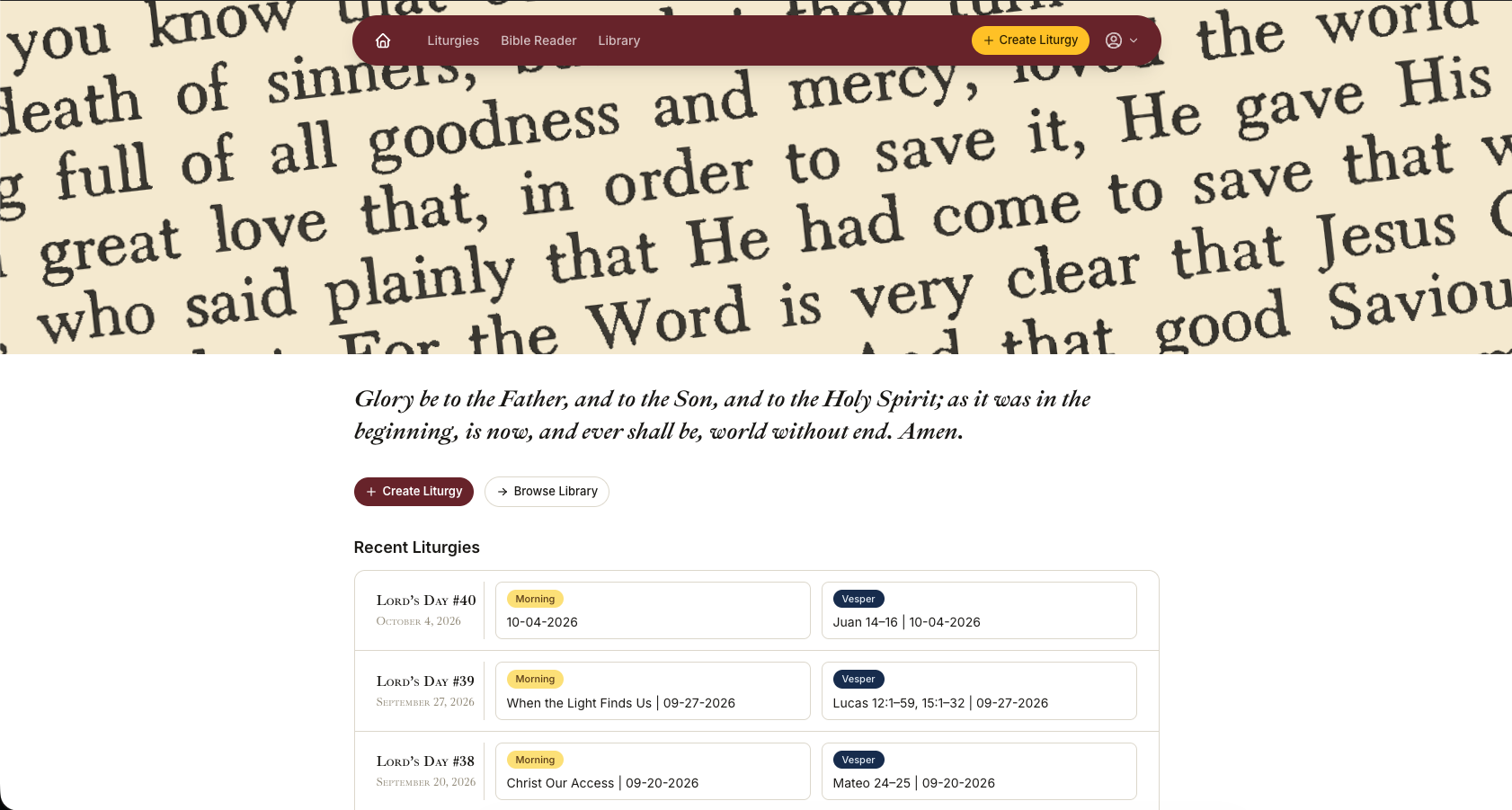
A production web application for Reformed Life Community Church that compiles Scripture, fixed liturgical formulas, prayer, and song into a complete order of worship: an in-app Scripture browser, a whole-service compile view, and native Word export. Live and in weekly use.
30–60 minDown from 2–3 hours of weekly compilation, with Curator review authority preserved.
50Active users across weekly worship, including one Curator and four Compilers.
Jul 2026v1 shipped and verified live in production.
01 · The problem
Every week, someone at Reformed Life Community Church had to turn Scripture, fixed liturgical formulas, prayer, and song into one coherent order of worship. The tooling was Docs, Sheets, and loose notes. That practice had three structural failures.
Nobody could see Call to Worship through Benediction as one continuous whole while writing it. Coherence had to be held in the crafter’s head.
With nothing surfacing what had already been used and why, the compiler reached for prior selections instead of choosing verses that built the day’s arc on purpose.
Even a well-chosen verse carried no record of how it was meant to be used: line divisions for responsive reading, adapted wording, the fixed formulas around it. The next person guessed at reasoning they were never there for.
02 · The standard
Two decisions set the floor for everything that followed.
The standard, set in the project’s founding document: the tool must produce a result equal to or better than the current manual process, with full dialogical structure, fixed formulas, and adapted Scripture preserved exactly as required, before it counts as viable. Ease of use is a bonus on top of that floor, not a substitute for it.
The first export pipeline rendered PDFs and grew fragile on multi-column layouts. Instead of patching it, the project became its own production successor: native Word (.docx) generation, with continuous-flow, multi-column authoring that Word itself lays out. The old pipeline was frozen in place, not deleted.
03 · The answer
Three design moves carry the weight: source the text, see the whole, and record the intent.
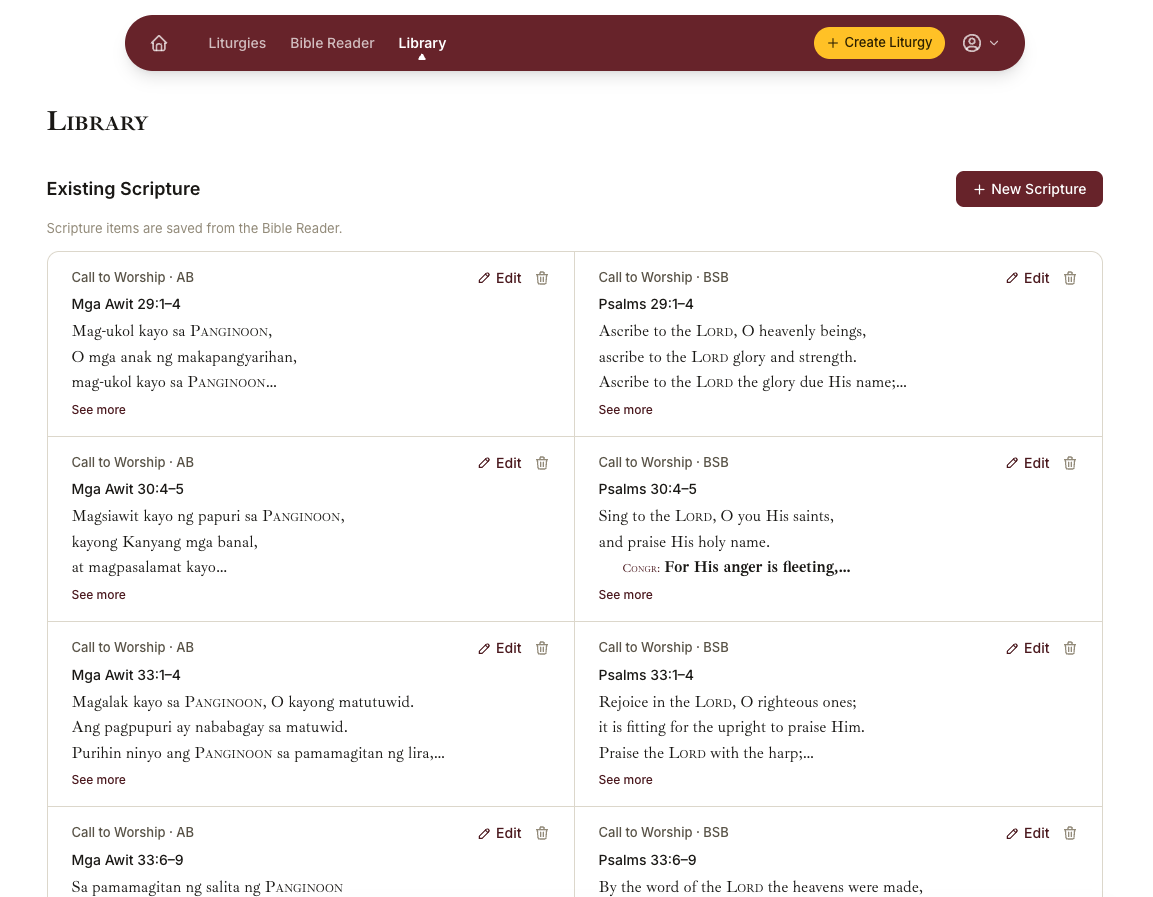
An in-app Scripture browser hosts the full Filipino (AB1905) and English (BSB) text directly in the application, with AB2001 available through a licensed widget. Compilers highlight any passage to assign it straight to a Section, keeping Scripture sourcing anchored to a single verified entry point.
Every Section of the template sits on one screen while the liturgy is built, so the whole service is visible at once instead of living in the compiler’s head. Fixed Morning and Vesper templates; the Lord’s Day number computes itself from the service date.
A liturgy is not flat prose. Different elements carry different authority, speaking roles, and export rules. The six-part model distinguishes locked canon from living prayer, responsive dialogues from silent rubrics, and Scripture citations from preaching metadata.
Pulls text directly from the Scripture browser, locks in verified chapter-and-verse citations, and preserves hand-adapted wording while keeping the reference intact.
Shared Formula wording stays fixed during ordinary service editing. Curators maintain the shared masters and can make a deliberate correction for one service without changing the Library or other services.
Provides spoken transitions and instructional rubrics for the leader, while compilation rules automatically keep staging directions out of the congregation’s bulletin.
Provides a curated library of corporate prayers—including the weekly confession of sin—alongside structural checklists for extemporaneous prayer.
Captures preaching metadata—passage reference, sermon title, series, and speaker—without treating the sermon like an arbitrary text block.
Catalogs psalms and hymns by title, tune, and metrical source, keeping copyright-clean records without storing lyric bodies.
Every item, including leader-only verbal cues, generated as a real Word document for the presiding leader.
Public-facing items only, from the same compiled service. Same source, tailored for the congregation.
A mobile-first, no-chrome page for any liturgy, linkable directly. No account needed to read.
The system, live
04 · Governed reuse
The shared library made knowledge reusable. The Curator governs shared material; the Compiler assembles each week’s service and can place their own Formula proposals. Review is what turns a personal proposal into shared material.
Maintains the shared library, reviews personal proposals, and controls shared Formula masters. Curators can also use a separate Correct wording action for one service, without changing the Library or other services.
Builds each service from shared material and personal proposals. Shared wording stays fixed during ordinary editing; Compilers can adapt their own unpromoted proposals and adjust permitted presentation settings.
Example: Absolution. These figures use an Absolution Formula to show the two roles. The Curator reviews a proposed version and maintains the shared library master. The Compiler selects that Formula for the weekly service. A personal proposal goes to Curator review before becoming shared material.
Canon and freedom, side by side: shared Formula wording stays fixed in ordinary service editing, while personal proposals remain adaptable by their owner. Curators can deliberately correct one service without altering the shared master or other services.
05 · The honest ledger
Stage honesty is part of the system. Here is the ledger as it stands.
Monday automation prepares the week’s Morning and Vesper services, creating and seeding drafts when needed. A Compiler still assembles each service. Saturday publication is built but paused; its checks require a Ready service and prevent the same revision from being recorded twice.
Shared Formula masters are Curator-controlled. Compilers can place shared material and their own proposals, while ordinary editing keeps shared wording fixed. A Curator can deliberately correct one service. Each placement records its wording so later Library changes do not silently rewrite that service.
The legacy PDF renderer stays in the codebase, frozen and untouched, reachable only by explicit query. It is not a supported source of present-tense output.
Section reordering, full library management, and cross-day citation warnings remain scoped and sequenced, not missing by accident.
Multi-dimensional taxonomy for library selections—classifying passages and prayers by doctrinal topic, biblical theme, liturgical calendar season, and emotional or pastoral tone—to guide service curation without guesswork.
Direct integration with the companion PowerPoint presentation builder, turning compiled responsive readings, creeds, and songs into projection slides without manual copy-pasting.
Offline capability through client-side data caching and downloadable service packages, ensuring presiders and worshippers can access the liturgy without depending on venue Wi-Fi.
The congregation reads the output every Sunday. The ledger stays public.
06 · Contact
If you’re hiring for AI operations, workflow systems, or application development, I’d be glad to discuss the role, and how to leave your team with systems that keep working after the project ends.
Choose a 20-minute slot that works for you. The calendar below shows my current availability.
If the calendar does not load, open the booking page directly.